
How to Choose a Local Mechanic: 2026 Guide
Table of Contents
Start With Referrals and Online Research
What to Look For in Online Reviews
Verify Credentials: ASE Certified Mechanic Benefits
Other Certifications That Matter
Evaluate the Shop Environment and Equipment
Questions to Ask a Mechanic Before Repair
How to Verify the Answers, Not Just Hear Them
What to Listen For in the Answers
How to Get a Quote for Car Repair
Understanding the Written Estimate
Red Flags in Repair Invoices and Warranty Policies
Special Considerations for Modern Vehicles
EV and Hybrid: What to Ask Before You Hand Over the Keys
The Right to Repair: Why It Affects Your Choice
Digital Transparency: The Modern Vetting Metric
Conclusion
Frequently Asked Questions
Last Updated: September 18, 2026
Start With Referrals and Online Research
Finding a trustworthy local mechanic starts with two sources: people who already trust you, and the public record of a shop's work. According to AAA's guidance on finding a reliable auto repair shop, asking friends, family, and coworkers for recommendations remains one of the most reliable ways to find a repair facility, because you're hearing about real experiences rather than advertising.
What to Look For in Online Reviews
Read for patterns, not individual complaints. Every shop has a bad review or two; what matters is whether the owner responded, and whether the complaint repeats across multiple reviewers.
Recurring themes: Do multiple reviewers mention the same problem, like surprise charges or slow communication?
Specific praise: Reviews that name a certified technician, a repair order number, or a completed job are more credible than vague five-star ratings.
Recency: A shop that was excellent three years ago may have changed ownership or staff. Prioritize reviews from the past 12 months.
Response quality: How a shop replies to criticism tells you more about its customer service than its marketing does.
Verify Credentials: ASE Certified Mechanic Benefits
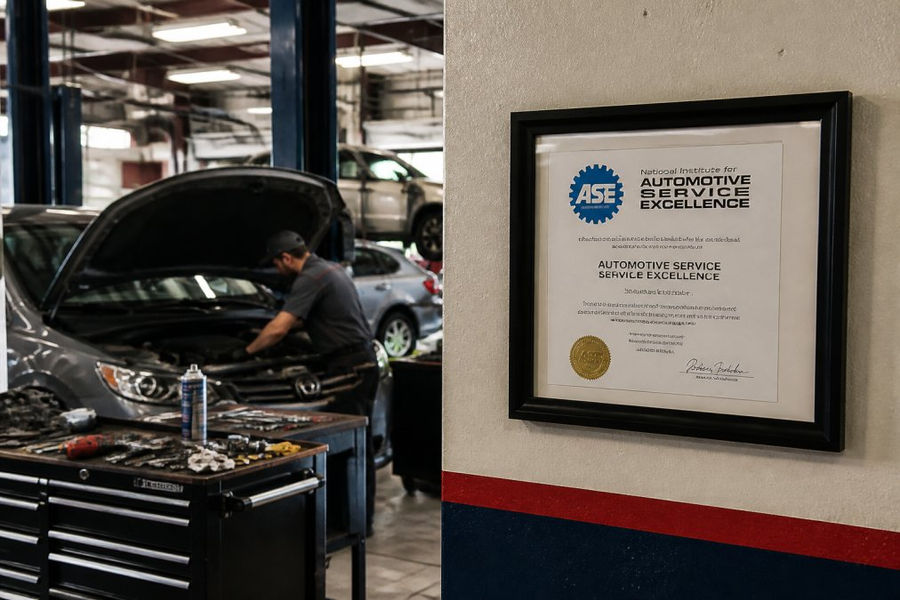
The clearest signal of a qualified technician is ASE certification. ASE certification is a voluntary credential from the National Institute for Automotive Service Excellence that requires passing standardized exams and proving hands-on work experience.
Other Certifications That Matter
ASE is the baseline, not the ceiling. Look for these additional credentials:
ASE Master Technician: A technician who has passed all available certification tests in a specialty area.
Manufacturer-specific training: Factory programs from major automakers, which signal familiarity with a particular brand's systems.
State licensing: Many states require repair facilities to register or license with a consumer protection agency. Verify the shop's standing there.
Evaluate the Shop Environment and Equipment
A shop's physical space tells you how it treats your vehicle. You don't need to be a mechanic to notice the difference between a well-run repair facility and a chaotic one.
Questions to Ask a Mechanic Before Repair
The questions you ask before work begins reveal how a shop operates. According to Consumer Reports' advice on navigating auto repair, being specific and direct with a service advisor is the best way to avoid misunderstandings later. But the value isn't in the questions themselves, it's in how you verify the answers. A shop can say anything; a shop that hands you documentation is a different category of business.
Pricing and authorization
Can you provide a written estimate before any work begins?
What's your diagnostic fee, and does it apply toward the repair if I approve the work?
What's your labor rate, and is it posted?
If you find additional problems, will you call for approval before doing the work?
Parts and warranty
Will you use original equipment manufacturer (OEM) parts or aftermarket parts, and why?
What's your warranty coverage on parts and labor, and is it honored at other locations?
Can I see the old parts after the repair is complete?
Diagnostics and access
What scan tools and diagnostic software do you use, and do you have current subscriptions?
How do you handle extended warranty claims, do you bill the provider directly, or do I pay and seek reimbursement?
Can you send me photos or a video of the failed component before you replace it?
How to Verify the Answers, Not Just Hear Them
A confident service advisor gives ranges, explains what could change the estimate, and says when they'll call before authorizing more work. But polished answers you can't verify are just as risky as vague ones. Use these checks:
Ask to see the scan tool in use. Modern shops use manufacturer-level or OEM-equivalent platforms. If a shop can't name its platform or show a live data screen, it may be reading codes with a generic consumer scanner and guessing.
Request a digital inspection report. Many shops send a link with photos or videos of the failed part, measured values, and the recommended repair. Ask upfront; a shop with the workflow says yes without hesitation.
Confirm the warranty in writing on the repair order. "We stand behind our work" is not a warranty. Ask the advisor to write the coverage terms, duration, parts vs. labor, transferability, directly on the estimate or repair order before you sign.
Ask who actually works on your car. Some shops subcontract specialty work (transmissions, alignments, electrical). That's not automatically bad, but know before you authorize the job, since it affects turnaround time and who honors the warranty.
Check whether the shop has access to manufacturer repair information. Independent shops rely on subscriptions for factory procedures, wiring diagrams, and software updates. If they lack current access for your make, complex repairs may end up at a dealer anyway.
Pro Tip Bring your questions in writing. A service advisor who answers a prepared list calmly and specifically is demonstrating exactly the communication style you'll want when the repair gets complicated.
What to Listen For in the Answers
Vague answers are a warning sign. "We'll figure it out once we get in there" is not a plan, nor is a refusal to put warranty terms in writing, a labor rate that changes when you ask for it in writing, or a diagnostic fee that grows once the car is on the lift. The best signal is a shop that volunteers information you didn't ask for.
How to Get a Quote for Car Repair
A proper quote for car repair is written, itemized, and signed before work starts. Anything less leaves you exposed to a bill that doesn't match what you were told.
Understanding the Written Estimate
A written estimate should include:
Diagnostic fee: The cost to identify the problem.
Parts: Itemized by name, with OEM or aftermarket designation.
Labor: Broken out by hours and labor rate.
Taxes and shop supplies: Any additional charges, listed separately.
Total: The full expected cost.
If a shop won't put it in writing, walk away. That's not a negotiation tactic; it's a red flag.
Red Flags in Repair Invoices and Warranty Policies
Watch for these patterns on your repair order and invoice:
Red Flag | What It Looks Like | Why It Matters |
Vague line items | "Misc. repairs" or "shop adjustment" | You can't verify what you paid for |
No parts breakdown | Single lump sum for parts | No way to confirm OEM vs. aftermarket |
Verbal-only warranty | "We stand behind our work" with nothing in writing | No recourse if the repair fails |
Pressure to approve extra work | "We can't let you leave with it like this" | Legitimate shops give you time and options |
Refusal to return old parts | "We already disposed of them" | You lose proof of what was replaced |
Special Considerations for Modern Vehicles
Modern vehicles, including EVs and hybrids, require different questions than a gas-powered car did a decade ago. Battery diagnostics, high-voltage safety training, and software update capability are now part of the job, and most guides haven't caught up.
EV and Hybrid: What to Ask Before You Hand Over the Keys
High-voltage systems in EVs and hybrids operate at hundreds of volts. Working on them without the right training and equipment is dangerous and a fast way to void a battery warranty. Ask directly:
Does the shop have technicians certified in high-voltage safety? Look for training through the vehicle manufacturer or recognized industry programs. A general ASE certification does not cover high-voltage work on its own.
Can they perform battery health diagnostics? This means state-of-health and state-of-charge testing, cell balance checks, and thermal management system inspection, not just reading a dashboard warning.
Do they handle software updates and recalls? Many EV and hybrid fixes are software, not hardware. A shop without current manufacturer software access will send you to a dealer for those.
Do they have the charging and isolation equipment required for the job? Insulated tools, PPE, and a designated high-voltage bay are baseline requirements, not nice-to-haves.
The Right to Repair: Why It Affects Your Choice
As vehicles become more software-dependent, access to diagnostic tools and repair information shapes what an independent shop can do. Right-to-repair activity has focused on whether owners and independent shops can access the same diagnostic data, tools, and service information franchised dealers receive. The practical effect:
A shop's tool access determines what it can fix. Two shops with equally skilled technicians can have very different capabilities if one subscribes to manufacturer diagnostic platforms and the other doesn't.
Software-locked repairs may require a dealer. If a repair requires a manufacturer server login or a proprietary calibration, an independent shop may be legally and technically unable to complete it.
Ask about data access before authorizing work. "Do you have current access to manufacturer diagnostic systems for my make?" is a fair question, and the answer tells you whether the shop can finish the job or will hand it off.
Digital Transparency: The Modern Vetting Metric
Most guides treat trust as a feeling. A more useful test is whether the shop uses digital inspection tools that show you what the technician sees. Look for:
Photo and video documentation of the failed component, sent to your phone before work is authorized.
Measured values, voltage, resistance, pressure, tread depth, not just "it's bad."
A shareable report link you can keep, forward to a second opinion, or use if you dispute the diagnosis later.
Key Takeaway For modern vehicles, the right questions aren't about trust, they're about tool access, certification scope, and documentation. A shop that can answer all three specifically is a shop equipped to work on the car you actually drive.
Conclusion
Choosing the right local mechanic comes down to verification: verified credentials, a verified written estimate, and a verified warranty policy. At Cruiser Auto Repair, our professionally qualified technicians provide transparent, competitive pricing and handle extended warranty repairs directly with your provider, so you're not stuck in a claims back-and-forth. We also offer prompt breakdown services. Schedule your appointment with Cruiser Auto Repair and get a straight answer about what your vehicle actually needs.
Frequently Asked Questions
What certifications should a reputable local mechanic have?
Look for ASE (Automotive Service Excellence) certification, which requires passing standardized exams and ongoing training. Many manufacturers also offer brand-specific certifications. A reputable shop will display these credentials and have technicians with current training. ASE certification covers areas like brakes, engine repair, and electrical systems, giving you confidence in their expertise.
How can I tell if a mechanic is overcharging me?
Compare quotes from multiple shops for the same repair. Ask for a written estimate that breaks down parts and labor separately. Labor rates vary by region, but a fair rate reflects the shop's overhead and expertise. Be wary of vague estimates, pressure to approve unnecessary work, or prices far below market average, which can signal inferior parts. Transparent shops explain costs clearly.
What is the $3,000 rule for car repairs?
The $3,000 rule is a general guideline suggesting that if repair costs exceed $3,000 or half the vehicle's value, it may be time to consider replacing the car. This isn't a hard rule; factors like vehicle age, mileage, and overall condition matter. For newer cars or those with sentimental value, a major repair can still be worthwhile. Discuss options with your mechanic.
How do I get a quote for car repair without committing to the work?
Request a written estimate before authorizing any repairs. A reputable shop will provide a detailed quote listing parts, labor, and any diagnostic fees. Some shops charge a diagnostic fee to inspect the vehicle, which is often applied to the repair cost if you proceed. Don't feel pressured to decide on the spot. Take the estimate home and compare it with other shops if needed.
SCHEDULE YOUR APPOINTMENT


Comments